

The search for the best blinds for heat reduction is more than an aesthetic choice; it is a critical strategy for home climate control. Standard windows account for a significant portion of a home’s cooling loss, directly impacting your wallet and comfort. By selecting the right window treatments, homeowners can transform their living spaces into thermally efficient environments that resist the most intense solar cycles.
- Benefits of energy-efficient window coverings:
- Immediate reduction in solar heat gain during peak sun hours.
- Protection for interior furniture and flooring against UV fading.
- Enhanced privacy without sacrificing natural light.
- Lower carbon footprint through reduced HVAC dependency.
Data shows that implementing Beat the Heat: Energy-Efficient Shades can reduce heat gain by up to 77%. Homeowners often see cooling costs drop by 10% to 30% when switching to smart shading technology that responds to environmental changes in real-time.
Understanding Solar Heat Gain: The Science of Cooling
Managing temperatures in coastal Florida homes requires an understanding of how light becomes heat. When solar radiation strikes a window, it is either reflected, absorbed, or transmitted into the living space as thermal energy. To mitigate heat transfer effectively, window treatments must address the specific challenges of Florida humidity and intense UV exposure. Window treatments mitigate solar heat gain by providing a physical barrier that disrupts the path of energy. Infrared radiation penetrates standard window glass easily, but low-emissivity materials reflect thermal energy back toward the source to keep interiors stable.
- Components of solar radiation:
- Ultraviolet (UV): Causes material degradation and fading.
- Visible Light: Provides illumination but contributes to glare.
- Infrared (IR): The primary source of radiant heat.
How Radiant Heat Interacts with Fenestration Materials
Window glass acts as a bridge for thermal energy. Standard clear glass allows high levels of infrared radiation to pass through, which then warms objects inside the room. These objects re-radiate heat, creating a greenhouse effect. High-performance blinds act as a secondary barrier, reflecting this radiation back through the glass before it can raise the indoor ambient temperature. This process is essential for maintaining a stable microclimate within the home.
The Role of Emissivity in Thermal Regulation
Emissivity refers to a material’s ability to emit radiant energy. Window treatments with low-emissivity (Low-E) coatings or specialized metallic backings are designed to keep heat on the side of the blind where it originates. In the summer, this means reflecting exterior heat away, while in the winter, it helps retain internal warmth. By lowering the emissivity of the window assembly, homeowners can significantly reduce the energy required to maintain comfortable temperatures.
Top 5 Types of Blinds for Maximum Heat Reflection
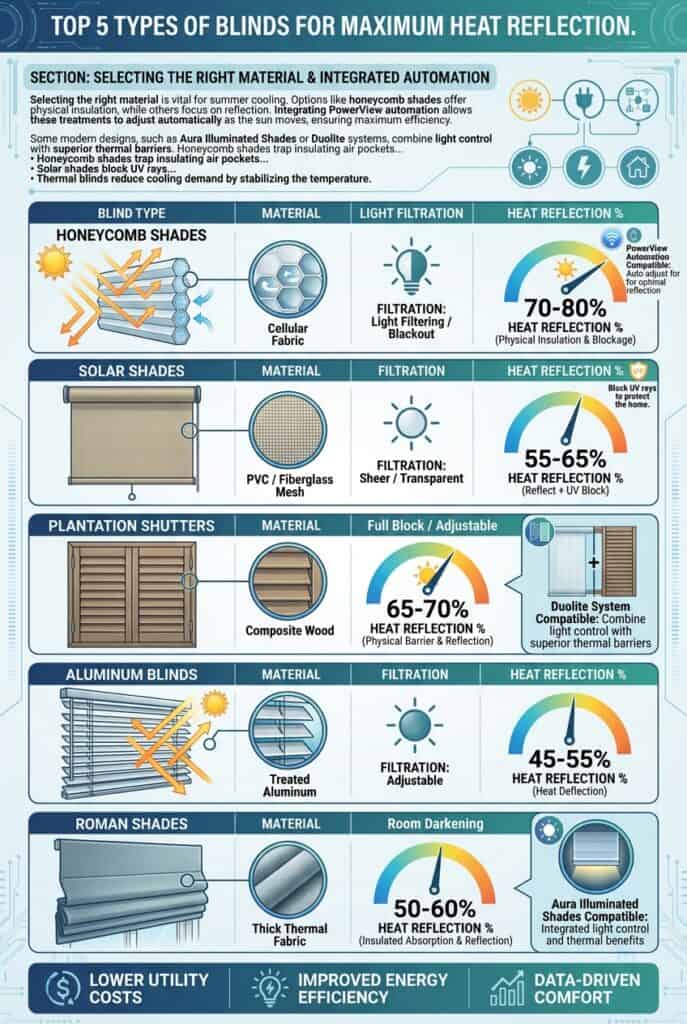
Selecting the right material is vital for summer cooling. Options like honeycomb shades offer physical insulation, while others focus on reflection. Integrating PowerView automation allows these treatments to adjust automatically as the sun moves, ensuring maximum efficiency. Some modern designs, such as Aura Illuminated Shades or Duolite systems, combine light control with superior thermal barriers. Honeycomb shades trap insulating air pockets within their structure to block the passage of heat. Simultaneously, solar shades block UV rays to protect the home while thermal blinds reduce cooling demand by stabilizing the temperature.
| Blind Type | Material | Light Filtration | Heat Reflection % |
|---|---|---|---|
| Cellular/Honeycomb | Double-cell Polyester | Blackout/Sheer | 75-80% |
| Solar Shades | Vinyl-Coated Fiberglass | Transparent | 60-70% |
| Roman Shades | Thick Thermal Fabric | Room Darkening | 50-60% |
| Aluminum Blinds | Treated Aluminum | Adjustable | 45-55% |
| Plantation Shutters | Composite Wood | Full Block | 65-70% |
Cellular Shades: The Ultimate Insulating Barrier
Cellular shades, or honeycomb shades, feature a unique pleated design that creates distinct air pockets. These pockets act as insulators, significantly slowing the transfer of heat through the window. Because air is a poor conductor of heat, the trapped layers within the cells create a robust thermal break that is effective in both extreme heat and cold.
Solar Shades: Blocking UV without Losing the View
Solar shades are engineered with a technical weave that allows you to see outside while blocking a high percentage of UV and infrared rays. They are the ideal choice for rooms where maintaining a view of the coastline is a priority. These shades are categorized by “openness factors,” allowing homeowners to balance visibility with heat protection.
Reflective Roller Shades for High-Exposure Areas
Roller shades with a high-performance white or metallic backing provide excellent reflection. By bouncing light back through the window, they prevent the fabric itself from heating up and radiating warmth into the room. This is particularly effective for large expanses of glass that receive direct sunlight for several hours a day.
Thermal Roman Shades: Style Meets Efficiency
Roman shades using heavy, multi-layered fabrics provide a thick barrier against heat. When paired with a thermal liner, they offer some of the highest R-values in the industry. These treatments are excellent for bedrooms where both light exclusion and temperature control are paramount for sleep quality.
Composite Shutters for Durable Heat Control
Composite shutters are dense and fit tightly within the window frame. This tight fit minimizes air leakage, while the synthetic materials resist warping in high-heat and high-humidity environments. Their solid construction provides a permanent architectural solution to solar heat gain.
Technical Analysis: R-Values and SHGC Explained
To find the most effective blinds, look at the technical specifications. The Solar Heat Gain Coefficient (SHGC) and R-values provide a data-backed foundation for your purchase. SHGC ratings measure solar heat transmission through the window assembly, with lower numbers indicating better performance. High R-values indicate superior thermal resistance, meaning the material is better at preventing heat from moving through it.
| Material Type | R-Value (Single Layer) | SHGC (Lower is Better) |
|---|---|---|
| Single Cell Honeycomb | 2.2 | 0.25 |
| Double Cell Honeycomb | 4.5 | 0.18 |
| Blackout Roller Shade | 1.5 | 0.22 |
| Wood Plantation Shutter | 3.1 | 0.28 |
- Recommended SHGC ratings: In hot climates like Florida, look for an SHGC of 0.25 or lower to ensure the blind blocks at least 75% of solar heat.
Installation Tips: Minimizing Gaps and West-Facing Heat
Even the best blinds fail if installed incorrectly. A window treatment consultation ensures that professional custom measures are taken to eliminate “light gaps” where heat can leak in. Proper installation ensures that the window treatment functions as a complete system rather than just a decorative hanging.
- Step-by-step for side channels:
- Mount the blind as close to the glass as possible to minimize the air volume between the shade and the window.
- Install U-shaped side channels or LightLock technology on the window frame.
- Ensure the blind edges slide within these channels to block 100% of perimeter light and heat.
FAQ: How do I stop heat leaks at the edge of my blinds?
Side channels or “light blockers” are the most effective solution. These adhesive or screw-in tracks cover the vertical gaps between the shade and the window jamb, preventing “halo” lighting and thermal bypass, which can significantly degrade the efficiency of the blind.
Strategies for West-Facing Windows
West-facing windows receive the most intense, direct afternoon sun. This is when temperatures peak and HVAC systems are under the most stress. Using blackout-lined shades with high reflectivity in these specific locations is the most effective way to lower your daily AC load and prevent “hot spots” in your home.
The Importance of Tight Seal Installations
A tight seal against the window frame creates a dead-air space. This trapped air acts as an additional layer of insulation, preventing the hot air near the glass from circulating into the rest of the room. Without a tight seal, convective currents can carry heat around the edges of the blind, neutralizing much of its reflective benefit.
Cost vs. Energy Savings: The ROI of Thermal Blinds
Investing in quality window treatments provides a tangible return. While the initial cost is higher than “off-the-shelf” options, the long-term ROI of custom treatments is found in reduced utility bills and increased home value. Using sustainable power options like solar chargers for motorized shades can further reduce operational costs. Energy-efficient shades slash utility bills by reducing the runtime of air conditioning units. Professional installation maximizes product ROI by ensuring the thermal seal is complete and the hardware operates at peak efficiency.
- Factors influencing ROI:
- Local electricity rates (higher rates mean faster payback).
- Window orientation (South and West windows offer the most savings).
- Product lifespan (Custom treatments typically last 10-15 years longer than ready-made versions).
Conclusion: Choosing the Best Blinds for Year-Round Comfort
The right window treatments transform your home into a sanctuary of efficiency. By focusing on high R-values and low SHGC ratings, you can maintain a cool interior regardless of the Florida sun. Whether you choose custom upholstery for a cohesive look or technical solar shades for performance, the goal remains the same: comfort and sustainability.
FAQ: Which blind type is best for my specific climate?
For hot, humid climates, cellular shades with a blackout liner offer the best performance. If humidity is the primary concern, composite shutters or vinyl-based solar shades resist moisture while reflecting significant heat without the risk of mold or warping.
- Buyer’s Checklist:
- Check for Low-E or reflective backings.
- Confirm custom measurements for a gap-free fit.
- Look for “Cool-Condition” certified fabrics.
- Consider top-down bottom-up functionality for light and heat control.